
Home » Hair Transplants » FUE vs FUT
Which one is right for me?
FUE vs FUT

Surgeon-led, no-shave FUT & FUE performed by Dr. Imami and his experienced transplant team for natural hairline restoration and premium patient care.
Patient Testimonials
What Our Patients Say
GOODTrustindex verifies that the original source of the review is Google. Dr Imami & his entire staff were warm, welcoming, professional, and kind from the first call to the walk out to the car after the procedure by Dr. Imami. There are many Dr's practices set-up to be professional, efficient, providing great results; I've been to many. Then there are Dr's. practices that create a culture of kindness, healing, respect, & love along with being professional and efficient; these are rare diamonds. Dr. Imami's practice & the environment he has cultivated over a long successful career extents from his practice to all the people he has touched, healed, and helped along the way. If you are considering any type of restorative elective procedure and are unsure, tentative, anxious about these types of procedures, reach out to Dr. Imami and his team, you will feel cared for the moment he picks up the phone. Thank you so much for helping pacients, teaching physicians, and having such a strong ethos of healing & caring. Best Regards, and god bless to you your family and your two sons! PS I can't wait to see the results from my FUT procedure sprout & grow 🙂 Eric Blaufarb Update for those who may be unsure how well this procedure works I've added 2 photos. It's been about 4 months and the transplants are really coming in! I cannot express how excellent the technicians were they spent 8 hours of focused work and their talent & dedication is unmistakable with these results!
Owner's reply
Wow—thank you for such a thoughtful and kind review! Your words truly mean the world to Dr. Imami and our entire team. We are honored to be part of your journey and grateful that you felt cared for from start to finish. Creating a culture of kindness, healing, and respect is at the heart of what we do, and knowing that this resonated with you is incredibly rewarding. We’re excited for you to see the full results of your FUT procedure and look forward to celebrating your progress with you! Eric, please don’t hesitate to reach out if you ever need anything. Wishing you all the best, and thank you again for your trust and support!Posted on GoogleTrustindex verifies that the original source of the review is Google. Great experience every time, Dr. Imami is always involved and makes great recommendations. There are a lot of other options available there to assist in hair restoration so make sure to ask. Carrie is just an absolute doll and ensures you are comfortable at all times. Thanks team! 🙂Posted on GoogleTrustindex verifies that the original source of the review is Google. ⭐️⭐️⭐️⭐️⭐️ I recently had a hair transplant at Imami Skin and Cosmetic Center, and I can't express how thrilled I am with the results! If I could give more stars, I definitely would. The entire team was incredibly supportive throughout the process, answering all my questions and making me feel at ease. The staff was amazing—professional, friendly, and truly dedicated to providing the best care. Scheduling my appointment was a breeze, and they accommodated my needs perfectly. I highly recommend Imami Skin and Cosmetic Center to anyone considering a hair transplant. Thank you so much for everything!
Owner's reply
Thank you Eric for your amazing review! We’re absolutely thrilled to hear how happy you are with your hair transplant results. Our team takes great pride in providing exceptional care, and it means so much to know that you felt supported and at ease throughout the process. We truly appreciate your kind words about our staff and your recommendation—it’s the highest compliment we could receive! If you ever need anything in the future, we’re always here for you.Posted on GoogleTrustindex verifies that the original source of the review is Google. Dr. Imami and the team did an excellent job with my FUE treatment. Also very easy to communicate with. I was very anxious and nervous about what to expect before doing the procedure, but Dr. Imami and the team answered every question and addressed every concern I had and the procedure went super smoothly. Everyone is super friendly and caring and they definitely made me feel comfortable. Recovery is also pretty quick. It's been about 4 weeks now. Can't wait to see the growth in the coming months. Highly recommend Dr. Imami for hair restoration!
Owner's reply
Matthew, thank you so much for your thoughtful review! We're thrilled to hear about your positive experience with Dr. Imami and the team. It’s our goal to provide a caring and comfortable environment while addressing every question and concern. We're glad to hear your recovery is going smoothly, and we’re just as excited as you are to see your results in the coming months! Your kind words mean the world to us, and we truly appreciate your recommendation. If you have any questions or need anything as you continue your journey, don’t hesitate to reach out.Posted on GoogleTrustindex verifies that the original source of the review is Google. At the time of this writing, I am 8 months post my FUE procedure. When I started this, I had an advanced thinned crown and receding front hairline but was not totally bald. Needless to say, I was not happy when I looked in the mirror. I was very uncomfortable (embarrassed) about even looking into hair restoration, but Dr. Imami and his staff were very understanding and wonderful people to work with. Dr. Imami did 100% oversee every part of the prep, the FUE procedure, and the post/follow-up procedures I have done with them. Yes, he has technicians that perform the procedure under his supervision, as every one of these offices do, so I don't know what a couple other reviewers that I saw on here were complaining about (if they weren't actually fake reviews). If you are wondering, the FUE procedure itself wasn't bad. A little uncomfortable until the numbing injections kick-in, but fine after that. The first couple of nights after the procedure are a bit uncomfortable. I had to sleep in a recliner for the first two nights to keep the pressure off of the donor area. For me the recipient areas were relatively pain free right through the full healing period. I think I just had more nerves in the donor area. Your experience may vary. I am very happy with the results so far, and I will be moving forward with a second procedure to get everything to where I want things to be. I was a little worried about doing things in stages, but it has worked out very well for me. The changes have been substantial, but subtle/gradual enough over the first 6-month healing and growing period, where people I work with and people who had not seen me in months, were not able to tell what had changed about me (even close relatives). And yes, I did strategically wear baseball hats and such for the first month after the surgery. 🙂 I was also happily surprised with the cost of the procedure. I initially went in thinking they were going to tell me a huge number, and I would then walk away, saying no way can I afford that. Thats not what happened though, so don't walk away from checking this out thinking you can't afford it, because you may be surprised like I was. Not to sound crazy or anything, but this has not just restored my hairline, it has restored my self-image. I was seriously depressed with myself. Looking in the mirror was painful for me. Doing this started me down a healthier path with myself. It helped me get serious about losing weight and getting in shape as well. I feel great and I look better than I have in 15 years. If you are thinking about doing this, do it. I wish I hadn't waited as long as I did.Posted on GoogleTrustindex verifies that the original source of the review is Google. I am 5 months post-surgery for the FUE hair transplant I had done. This review is in relation to where my hair is at now. I will update this review at 12-13 months when the results are fully established. Getting this surgery done was one of the largest decisions I have made and spent roughly two years researching the procedure. I am 25 years old and for the first time in three years, I am able to feel comfortable again. I am very pleased with the results so far and have seen extensive growth in the past month. My hairline is natural looking and my crown is slowly filling in. I kept my head shaved up until a month and a half ago and even shaved, nobody was able to notice the "dot" scars from the donor site unless pointed out and meticulous observed (it helps that I have a very fair complexion). With my hair grown more, the donor site looks 99.99% untouched and I am the only person who can tell and even then, it is still virtually unnoticeable. In regards to the procedure, I felt very comfortable the second I walked through the doors and Dr. Imami and his team displayed professionalism and expertise the entire way through. Dr. Imami's team conducted the vast majority procedure and I felt in very comfortable and capable hands. When the results are fully evident, I will share before and after photos. However, for now, I do not want to share any photos as the results are still preliminary. However, I confidently say that I am very pleased with the progress made thus far. I realize how difficult the decision for this procedure is so please feel free to reach out to me if you have any questions or concerns! I genuinely say that I am very happy that I went through with this procedure with Dr. Imami and his team and it has reinvigorated my confidence. This review was done fully on my own-terms and not asked for or promoted at all but rather to encourage others to consult here and share my satisfaction. —— Update 09/01/2023 Continued 5 stars. A new breath of life. Highly recommend Imami Hair Restoration for FUE procedures. Only positive experiences. It’s been about 2.5 years since my original procedure. The FUE procedure and similar hair restoration procedures and techniques seem to have continuously grown in popularity with more and more traveling abroad for them. Nothing wrong with that — if you do extensive research. Personally, I made the decision to get it done locally in the U.S. for a very reasonable price. Anyways, I’m happy. I’m more confident. Most importantly, I feel like me again. People don’t notice my FUE dots unless I point them out — and that’s coming from a guy who STILL gets skin fades. Overall, one of the best decisions I’ve made. It’s not for everyone. Be prepared to take finasteride daily for as long as you want your head of hair. Just the nature of the beast. It’s not a miracle — but it’s damn impressive. The meds aren’t for everyone. Not everyone will react well to fin. You’ll read a lot of horror stories online. I chalk this up to an inverse survivorship bias where the minority with bad experiences share while the vast majority with positive experiences don’t share. Personally for me, no notable sides. Don’t go into this expecting a miracle. Taper your expectations and appreciate research, skill, technology, and medicine. At the end of the day, theres potential to bring life back to a balding head — in this case, the balding head of someone in their early 20s. Photos: Before and afters should be obvious — hopefully lol. Taken at least 14 months post op AND finasteride use. Photo of top of head uses flash.
Owner's reply
Thank you very much for your comprehensive review Tyler! Dr. Imami has very high standards for quality and professionalism, so we're glad that was what you experienced. We hope the final results meet your expectations.Posted on GoogleTrustindex verifies that the original source of the review is Google. The staff are charming, charismatic, and helpful. I had a very positive experience.

Our Approach
Reclaim Your Confidence
Both the FUE (Follicular Unit Extraction) and FUT (Follicular Unit Transplant) are highly effective methods for transplanting hair. Below we describe and summarize who are the best candidates for each procedure and how to select the appropriate transplant procedure.
Real Results
See the Results for Yourself
Browse our before-and-after gallery to see the results our patients have achieved at Imami Hair Restoration.
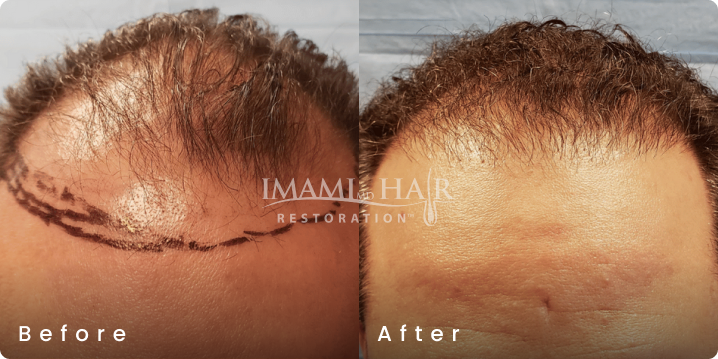
No Shave FUE
Age: 37 | Norwood 3
Grafts Placed
1,112 Grafts
Timeline
1 Year Post -Op
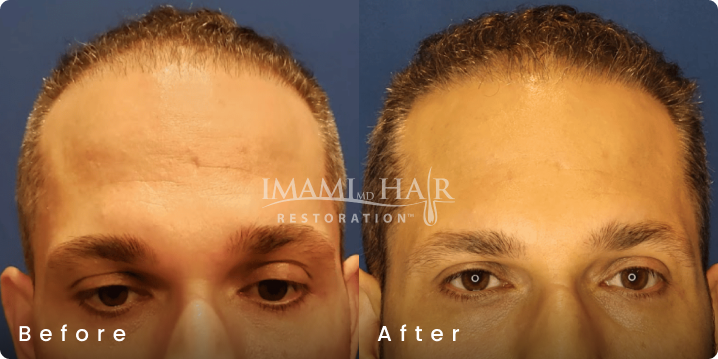
No Shave FUE
Age: 39 | Norwood 3
Grafts Placed
1,647 Grafts
Timeline
19 Months after 2nd FUE
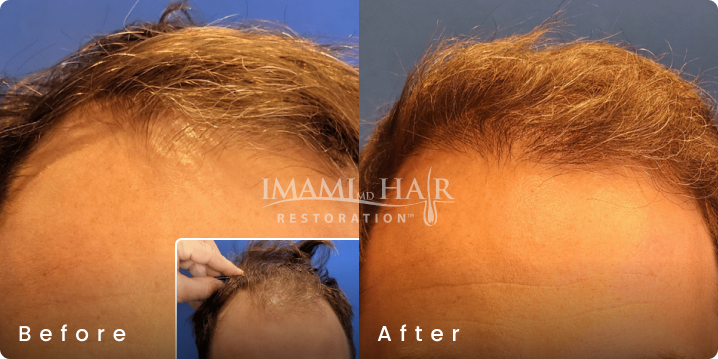
No Shave FUE
Age: 61 | Norwood 4A
Grafts Placed
1,205 Grafts
Timeline
15 months Post-Op
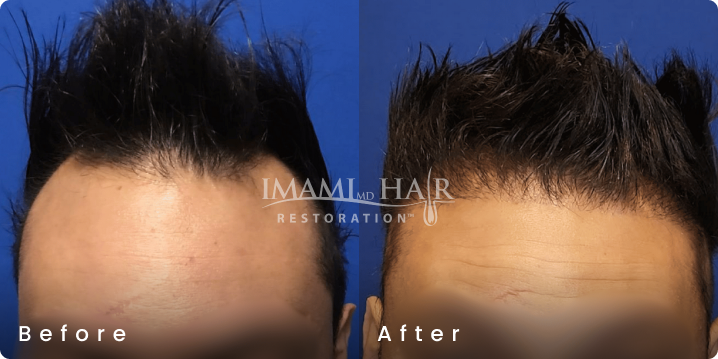
No Shave FUE
Age: 32 | Norwood 3
Grafts Placed
1,800 Grafts
Timeline
1 Year Post-Op
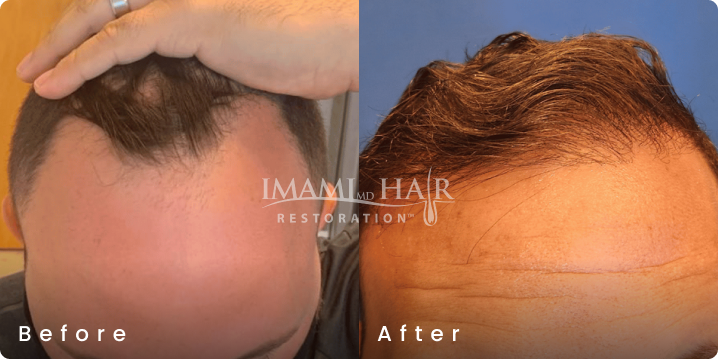
No Shave FUE
Age: 33 | Norwood 3A
Grafts Placed
1,750 Grafts
Timeline
4 Years Post -Op
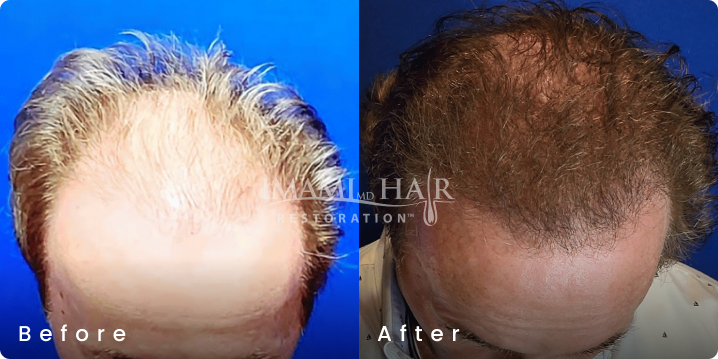
No Shave FUE
Age: 66 | Norwood 5
Grafts Placed
1,350 Grafts
Timeline
1 Year Post-Op
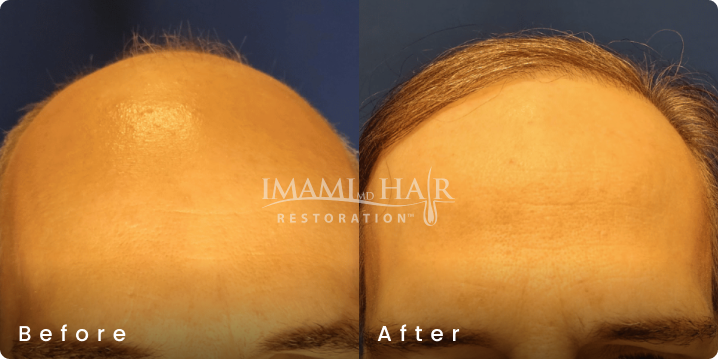
No Shave FUT
Age: 47 | Norwood 6
Grafts Placed
1,880 Grafts
Timeline
18 Months Post -Op
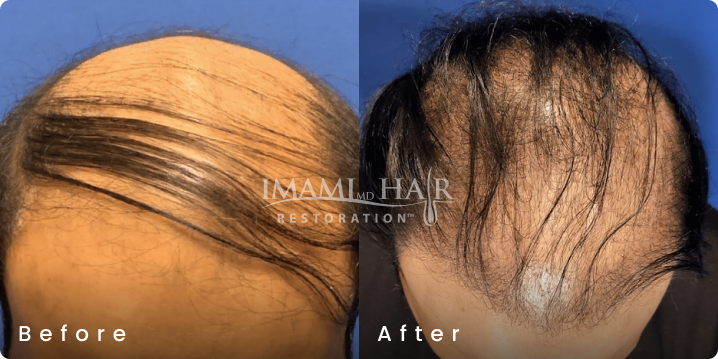
No Shave FUT
Age: 29 | Norwood 6
Grafts Placed
1st FUT 1,800 Grafts
2nd FUT
1,801 Grafts
Timeline
18 Months after 2nd FUT
The images above are displayed with the consent of the patients. The outcomes shown are only relevant for these patients and do not necessarily reflect the results other patients may experience. Our team will discuss any factors that could influence the results that you may get.

Candidates
Who is a Good Candidate for FUE?
Who May Not be a Good Candidate for FUE?
Patients who need large graft counts should opt for either FUT or the FUT-FUE combination. Using FUE for large donor graft cases risks prematurely depleting the safe donor area. Patient who do want the back of head clipped short as required for the FUE, may opt for the FUT. Another option for them is the “No Shave FUE” wherein thin linear strips of scalp are clipped and the overlying hair from above covers and conceals the donor site (see No Shave FUE).
Patients with multiple medical problems, heavy tobacco users and those on blood thinners are evaluated on an individual basis by Dr. Imami during the consultation.
Candidates
Who is a Good Candidate for FUT?
Ideal candidates are usually healthy men between the ages of 26 to 75. Women are also candidates. FUT can be used for both small and large graft cases. It is the preferred solution for large volume cases as it allows us to harvest the most grafts per cm2. This allows you to retain larger untouched areas in the safe donor area for future use by either FUT or FUE.
With FUT one does not shave a large donor area on the back of the scalp. This conceals both the sutures and any linear scar with overlying hair immediately.

Who May Not be a Good Candidate for FUT?
Patients who need small graft counts may opt for either FUT or FUE. Since FUT can leave a visible linear scar, individuals who plan on wearing their hair very short may prefer the FUE. Patients with multiple medical problems, heavy tobacco users and those on blood thinners are evaluated on an individual basis by Dr. Imami during the consultation.

The Process
How FUE Works

Extraction
Individual follicles are carefully extracted using a microscopic punch tool.

Preparation
Grafts are inspected, sorted, and preserved in a specialized solution.

Site Creation
Precise recipient sites are carefully created, matching the hair’s natural angle and direction.

Implantation
Grafts are delicately placed into the sites for natural-looking density.
Extraction
Individual follicles are carefully extracted using a microscopic punch tool.
Preparation
Grafts are inspected, sorted, and preserved in a specialized solution.
Site Creation
Precise recipient sites are carefully created, matching the hair’s natural angle and direction.
Implantation
Grafts are delicately placed into the sites for natural-looking density.
Procedure
Comparison of FUE and FUT
| FUE (Follicular Unit Extraction) |
FUT (Follicular Unit Transplant) |
||
|---|---|---|---|
| Male/Female | Usually Men* | Men and Women | |
| Procedure | Harvesting method |
|
|
| Natural results |
|
|
|
| Donor Availability |
|
|
|
| Graft Survival |
|
|
|
| Scarring | Scar |
|
|
| Concealing Scar |
|
|
|
| Recovery | Pain |
|
|
| Numbness |
|
|
|
| Donor Area Healing Time |
|
|
|
| Recipient Area Healing Time |
|
|
|
| Stitches |
|
|
|
| Return to work |
|
|
|
| Cost |
|
|
|
* Large FUE sessions require shaving the scalp, which many women do not desire. Some women requiring a small number of grafts are still suitable candidates when their overlying hair conceals the donor site.
Procedure
- Usually limited to 2,000 grafts
- Repeat procedures can rapidly deplete the scalp
- Alternate donor sites include beard and body
- Able to harvest up to 3,000 grafts
- Repeat procedures slowly deplete donor area
- No alternate donor sites to scalp
- Grafts are fragile
- Good survival
- Grafts are robust
- Excellent survival
Scarring
- Hundreds or thousands of small white dots
- Often hidden with a short haircut
- If shaved, some patients may notice a cobblestone appearance
- A single linear scar along the lower back of the scalp
- Usually hidden with longer hair
- If shaved, the scar is noticeable
- Lengthen hair to 4 guard or longer
- Scalp micropigmentation
- Lengthen hair to 4 guard or longer
- Scalp micropigmentation
- Surgical scar excision and revision
Recovery
- 1–4 out of 10
- May require pain medication for 2–3 days
- 1–2 out of 10
- May require pain medication for 1–2 days
1 Large FUE sessions may require shaving the scalp, which many women do not prefer. Some women requiring a small number of grafts may still be suitable candidates when surrounding hair conceals the donor site.
Excellence
Why Choose
Dr. Imami

Triple Board-Certified
A rare distinction ensuring the highest standards of surgical safety, ethics, and aesthetic outcomes.

Surgeon-Led Procedure
Dr Imami directs his experienced hair transplant team for optimal extraction and site creation.

Personalized Design
Every hairline is custom-designed based on facial geometry, age, and long-term hair loss progression.

Wondering if FUE or FUT is the Right Procedure for You? Book a Consultation with Dr. Imami to Discuss Your Options.

Meet Dr. Imami
Emran R. Imami, MD, FACS
Hair Transplant Surgeon
Dr. Imami is a board-certified surgeon with two additional board certifications and over 30 years of experience in hair restoration. He is recognized as one of Florida’s most trusted and skilled hair transplant surgeons, specializing in advanced techniques such as FUE, FUT, PDO threads, low-level laser therapy and growth factor treatments.
He is an active member of the American Society of Hair Restoration Surgeons and the American Academy of Cosmetic Surgeons and a Fellow of the American College of Surgeons, bringing a high level of surgical precision and patient-focused care to his work.
Dr. Imami serves on the faculty at the Burrell College of Osteopathic Medicine, where he regularly teaches medical students and has worked with the same team of hair transplant technicians for 15 years. His passion, shared by his dedicated team, is rooted in a genuine desire to make a positive impact. He combines the scientific and artistic aspects of medicine with an understanding of the connection between appearance and psychological well-being.


Consultation
Request a Consultation with Dr. Imami
Begin with a private, surgeon-led consultation with Dr. Imami to discuss your hair loss concerns, suitability and expected outcomes.