
Home » Hair Transplants » FUT Hair Transplant
FUT Hair Transplant
FUT Hair Transplant in Florida: Follicular Unit Transplantation (Strip Method)

- Over 30 years of hair restoration experience
- Follicular Unit Transplantation (FUT) combines proven technique with artistic precision to restore fuller, natural-looking hair in a single session.
- Highly personalized treatment plans developed by Dr. Imami
- Advanced graft harvesting and implantation for optimal density and results
- Flexible after-hours online consultations and same-day virtual appointments available
- Triple board certified
- One-year follow-up included
- Hair growth guarantee policy available
This content has been medically reviewed by Dr Emran R. Imami, MD, FACS (Florida License ME56101), Board-Certified General Surgeon, Associate Member of the ISHRS
Patient Testimonials
What Our Patients Say
GOOD Based on 15 reviews
 Posted on Google
 eric blaufarb
Trustindex verifies that the original source of the review is Google.
Dr Imami & his entire staff were warm, welcoming, professional, and kind from the first call to the walk out to the car after the procedure by Dr. Imami. There are many Dr's practices set-up to be professional, efficient, providing great results; I've been to many. Then there are Dr's. practices that create a culture of kindness, healing, respect, & love along with being professional and efficient; these are rare diamonds. Dr. Imami's practice & the environment he has cultivated over a long successful career extents from his practice to all the people he has touched, healed, and helped along the way. If you are considering any type of restorative elective procedure and are unsure, tentative, anxious about these types of procedures, reach out to Dr. Imami and his team, you will feel cared for the moment he picks up the phone. Thank you so much for helping pacients, teaching physicians, and having such a strong ethos of healing & caring. Best Regards, and god bless to you your family and your two sons! PS I can't wait to see the results from my FUT procedure sprout & grow :-) Eric Blaufarb Update for those who may be unsure how well this procedure works I've added 2 photos. It's been about 4 months and the transplants are really coming in! I cannot express how excellent the technicians were they spent 8 hours of focused work and their talent & dedication is unmistakable with these results!
Owner's reply
Wow—thank you for such a thoughtful and kind review! Your words truly mean the world to Dr. Imami and our entire team. We are honored to be part of your journey and grateful that you felt cared for from start to finish. Creating a culture of kindness, healing, and respect is at the heart of what we do, and knowing that this resonated with you is incredibly rewarding. We’re excited for you to see the full results of your FUT procedure and look forward to celebrating your progress with you! Eric, please don’t hesitate to reach out if you ever need anything. Wishing you all the best, and thank you again for your trust and support!Posted on Google Melissa MunzGreat experience every time, Dr. Imami is always involved and makes great recommendations. There are a lot of other options available there to assist in hair restoration so make sure to ask. Carrie is just an absolute doll and ensures you are comfortable at all times. Thanks team! 🙂Posted on Google
 Eric Chambers⭐️⭐️⭐️⭐️⭐️ I recently had a hair transplant at Imami Skin and Cosmetic Center, and I can't express how thrilled I am with the results! If I could give more stars, I definitely would. The entire team was incredibly supportive throughout the process, answering all my questions and making me feel at ease. The staff was amazing—professional, friendly, and truly dedicated to providing the best care. Scheduling my appointment was a breeze, and they accommodated my needs perfectly. I highly recommend Imami Skin and Cosmetic Center to anyone considering a hair transplant. Thank you so much for everything!
Owner's reply
Thank you Eric for your amazing review! We’re absolutely thrilled to hear how happy you are with your hair transplant results. Our team takes great pride in providing exceptional care, and it means so much to know that you felt supported and at ease throughout the process. We truly appreciate your kind words about our staff and your recommendation—it’s the highest compliment we could receive! If you ever need anything in the future, we’re always here for you.Posted on Google Matthew SethDr. Imami and the team did an excellent job with my FUE treatment. Also very easy to communicate with. I was very anxious and nervous about what to expect before doing the procedure, but Dr. Imami and the team answered every question and addressed every concern I had and the procedure went super smoothly. Everyone is super friendly and caring and they definitely made me feel comfortable. Recovery is also pretty quick. It's been about 4 weeks now. Can't wait to see the growth in the coming months. Highly recommend Dr. Imami for hair restoration!
Owner's reply
Matthew, thank you so much for your thoughtful review! We're thrilled to hear about your positive experience with Dr. Imami and the team. It’s our goal to provide a caring and comfortable environment while addressing every question and concern. We're glad to hear your recovery is going smoothly, and we’re just as excited as you are to see your results in the coming months! Your kind words mean the world to us, and we truly appreciate your recommendation. If you have any questions or need anything as you continue your journey, don’t hesitate to reach out.Posted on Google Douglas NicholsonAt the time of this writing, I am 8 months post my FUE procedure. When I started this, I had an advanced thinned crown and receding front hairline but was not totally bald. Needless to say, I was not happy when I looked in the mirror. I was very uncomfortable (embarrassed) about even looking into hair restoration, but Dr. Imami and his staff were very understanding and wonderful people to work with. Dr. Imami did 100% oversee every part of the prep, the FUE procedure, and the post/follow-up procedures I have done with them. Yes, he has technicians that perform the procedure under his supervision, as every one of these offices do, so I don't know what a couple other reviewers that I saw on here were complaining about (if they weren't actually fake reviews). If you are wondering, the FUE procedure itself wasn't bad. A little uncomfortable until the numbing injections kick-in, but fine after that. The first couple of nights after the procedure are a bit uncomfortable. I had to sleep in a recliner for the first two nights to keep the pressure off of the donor area. For me the recipient areas were relatively pain free right through the full healing period. I think I just had more nerves in the donor area. Your experience may vary. I am very happy with the results so far, and I will be moving forward with a second procedure to get everything to where I want things to be. I was a little worried about doing things in stages, but it has worked out very well for me. The changes have been substantial, but subtle/gradual enough over the first 6-month healing and growing period, where people I work with and people who had not seen me in months, were not able to tell what had changed about me (even close relatives). And yes, I did strategically wear baseball hats and such for the first month after the surgery. :-) I was also happily surprised with the cost of the procedure. I initially went in thinking they were going to tell me a huge number, and I would then walk away, saying no way can I afford that. Thats not what happened though, so don't walk away from checking this out thinking you can't afford it, because you may be surprised like I was. Not to sound crazy or anything, but this has not just restored my hairline, it has restored my self-image. I was seriously depressed with myself. Looking in the mirror was painful for me. Doing this started me down a healthier path with myself. It helped me get serious about losing weight and getting in shape as well. I feel great and I look better than I have in 15 years. If you are thinking about doing this, do it. I wish I hadn't waited as long as I did.Posted on Google
 Tyler CopelandI am 5 months post-surgery for the FUE hair transplant I had done. This review is in relation to where my hair is at now. I will update this review at 12-13 months when the results are fully established. Getting this surgery done was one of the largest decisions I have made and spent roughly two years researching the procedure. I am 25 years old and for the first time in three years, I am able to feel comfortable again. I am very pleased with the results so far and have seen extensive growth in the past month. My hairline is natural looking and my crown is slowly filling in. I kept my head shaved up until a month and a half ago and even shaved, nobody was able to notice the "dot" scars from the donor site unless pointed out and meticulous observed (it helps that I have a very fair complexion). With my hair grown more, the donor site looks 99.99% untouched and I am the only person who can tell and even then, it is still virtually unnoticeable. In regards to the procedure, I felt very comfortable the second I walked through the doors and Dr. Imami and his team displayed professionalism and expertise the entire way through. Dr. Imami's team conducted the vast majority procedure and I felt in very comfortable and capable hands. When the results are fully evident, I will share before and after photos. However, for now, I do not want to share any photos as the results are still preliminary. However, I confidently say that I am very pleased with the progress made thus far. I realize how difficult the decision for this procedure is so please feel free to reach out to me if you have any questions or concerns! I genuinely say that I am very happy that I went through with this procedure with Dr. Imami and his team and it has reinvigorated my confidence. This review was done fully on my own-terms and not asked for or promoted at all but rather to encourage others to consult here and share my satisfaction. —— Update 09/01/2023 Continued 5 stars. A new breath of life. Highly recommend Imami Hair Restoration for FUE procedures. Only positive experiences. It’s been about 2.5 years since my original procedure. The FUE procedure and similar hair restoration procedures and techniques seem to have continuously grown in popularity with more and more traveling abroad for them. Nothing wrong with that — if you do extensive research. Personally, I made the decision to get it done locally in the U.S. for a very reasonable price. Anyways, I’m happy. I’m more confident. Most importantly, I feel like me again. People don’t notice my FUE dots unless I point them out — and that’s coming from a guy who STILL gets skin fades. Overall, one of the best decisions I’ve made. It’s not for everyone. Be prepared to take finasteride daily for as long as you want your head of hair. Just the nature of the beast. It’s not a miracle — but it’s damn impressive. The meds aren’t for everyone. Not everyone will react well to fin. You’ll read a lot of horror stories online. I chalk this up to an inverse survivorship bias where the minority with bad experiences share while the vast majority with positive experiences don’t share. Personally for me, no notable sides. Don’t go into this expecting a miracle. Taper your expectations and appreciate research, skill, technology, and medicine. At the end of the day, theres potential to bring life back to a balding head — in this case, the balding head of someone in their early 20s. Photos: Before and afters should be obvious — hopefully lol. Taken at least 14 months post op AND finasteride use. Photo of top of head uses flash.
Owner's reply
Thank you very much for your comprehensive review Tyler! Dr. Imami has very high standards for quality and professionalism, so we're glad that was what you experienced. We hope the final results meet your expectations.Posted on Google Brian LThe staff are charming, charismatic, and helpful. I had a very positive experience.

Our Approach
What is a FUT Hair Transplant?
Follicular Unit Transplantation (FUT) is an established surgical hair restoration procedure that involves removing a narrow strip of hair-bearing skin from the donor area, typically at the back or sides of the scalp, where the hair is generally more resistant to pattern hair loss. The follicular units within this tissue are then separated and transplanted into areas affected by thinning or hair loss.
Unlike older hair restoration techniques that used larger punch grafts, modern FUT involves dissecting the donor strip under magnification to isolate naturally occurring follicular units. These units typically contain one to five hair follicles and can be placed individually to create a natural-looking distribution of hair.
During the procedure, Dr. Imami removes a carefully measured strip of scalp from the donor area. The tissue is then microscopically dissected into individual follicular units and prepared for transplantation. The donor area is closed using a surgical technique that minimizes the appearance of the resulting scar.
The prepared follicular units are then carefully positioned into recipient sites created in areas of thinning or baldness. Their placement takes into account factors such as the natural direction, angle, and distribution of existing hair to help achieve a natural-looking result.
As the transplanted follicles retain the characteristics of their original donor area, they are generally expected to continue growing in the recipient area over the long term. The number of grafts that can be harvested and transplanted depends on factors such as the size and characteristics of the donor area, the extent of hair loss, and the individual’s treatment goals.
Real Results
FUT Hair Transplant Before and After Results
Browse our before-and-after gallery to see the results our patients have achieved at Imami Hair Restoration.
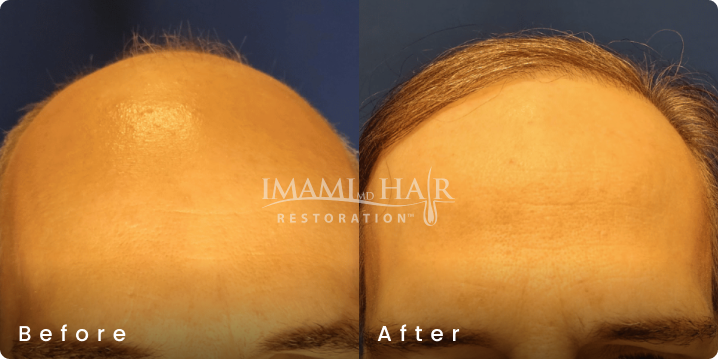
No Shave FUT
Age: 47 | Norwood 6
Grafts Placed
1,880 Grafts
Timeline
18 Months Post -Op
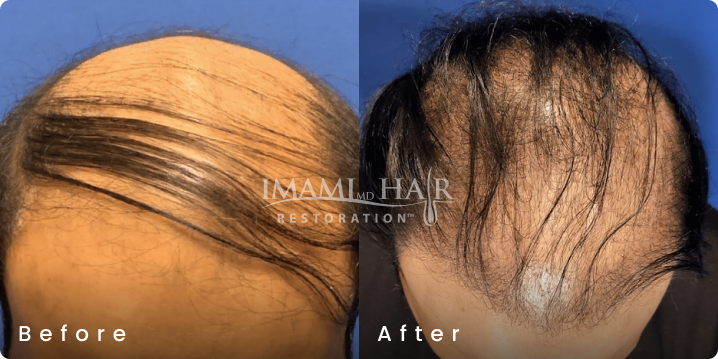
No Shave FUT
Age: 29 | Norwood 6
Grafts Placed
1st FUT 1,800 Grafts
2nd FUT
1,801 Grafts
Timeline
18 Months after 2nd FUT
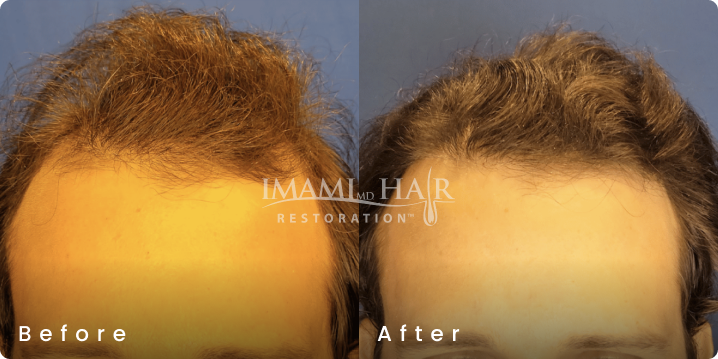
No Shave FUT
Age: 31 | Norwood 3
Grafts Placed
2,000 Grafts
Timeline
1 Year Post -Op
The images above are displayed with the consent of the patients. The outcomes shown are only relevant for these patients and do not necessarily reflect the results other patients may experience. Our team will discuss any factors that could influence the results that you may get.

Candidates
Who Is a Candidate for a FUT Hair Transplant?
FUT may suit some people experiencing hair loss who have an adequate supply of suitable donor hair and are considered appropriate candidates after an assessment. Factors that may be considered include:
- Male pattern hair loss (androgenetic alopecia)
- Female pattern hair loss
- Hair thinning or baldness affecting areas such as the hairline or crown
- Sufficient healthy donor hair at the back and sides of the scalp
- Overall health that is suitable for surgery
- Stable or appropriately assessed hair loss
- Realistic expectations about what hair transplantation can achieve
- A preference for FUT based on individual hair loss pattern, donor characteristics, and treatment goals
During a consultation, Dr. Imami can assess the extent and pattern of hair loss, the quality and density of the donor area, and the individual’s expectations to determine whether FUT is an appropriate treatment option.
Advantages
Benefits of a FUT Hair Transplant for Hair Loss
-
Restores Hair in a Single Session
FUT allows Dr. Imami to harvest and implant thousands of grafts in one procedure, often enabling patients to achieve their target density without multiple sessions. This means significant hair restoration in less time. -
Maximum Graft Yield
FUT can be a suitable option when a larger number of grafts are required. As the grafts are removed as a narrow strip of scalp rather than extracted individually, a substantial number of follicular units can be harvested during a single procedure. This can help make efficient use of the available donor hair while preserving other areas of the donor scalp for potential future treatment. -
Permanent, Natural-Looking Results
Transplanted hair retains its original genetic characteristics and will continue to grow naturally for life. When artistically placed by an experienced surgeon, results look completely natural and age naturally with you. -
Minimally Invasive with Predictable Recovery
Although FUT is a surgical procedure, it is performed under local anesthesia without general anesthesia. Downtime and discomfort are minimal compared to surgical procedures in other fields, and most patients return to light activities within a week. -
Concealed Donor Scar
With FUT, you do not need to shave a large donor area. The linear scar in the donor region is concealed by overlying hair immediately after the procedure, and it becomes less noticeable over time with the trichophytic closure technique. -
Cost-Effective for Larger Restoration Goals
As FUT allows maximum graft harvest in a single session, it is often more cost-effective than alternative procedures for patients with extensive hair loss.

The Technique
What is FUT?
FUT (follicular unit transplantation) removes a thin strip of hair from the back of the scalp, divides it into grafts of one to five hairs, and implants them where hair is thinning. Dr. Imami performs it no-shave, and closes the donor area with a trichophytic technique to minimise the scar.
Key Distinction
Unlike FUE, which extracts follicles one at a time, FUT removes a single thin strip, making it the most efficient option when a large number of grafts is needed.

What FUT Can Treat

Receding Hairline
Redesigning and lowering the hairline for a youthful frame.

Thinning Crown
Restoring density to the vertex for complete coverage.
Temple Restoration
Rebuilding temporal points for a balanced facial profile.

Scar Camouflage
Concealing previous surgical scars or trauma.

Hairline Refinement
Adding density to previous transplants or naturally weak hairlines.

Eyebrow Restoration
Recreating fuller, natural-looking eyebrows for both men and women.

The Process
How FUT Works

Strip Harvesting
A thin strip of hair is removed from the back of the scalp, and the donor area is closed with a trichophytic technique.

Preparation
The strip is divided into grafts of one to five hairs, then inspected, sorted, and preserved in a specialized solution.

Site Creation
Precise recipient sites are carefully created, matching the hair’s natural angle and direction.

Implantation
Grafts are delicately placed into the sites for natural-looking density.
Strip Harvesting
A thin strip of hair is removed from the back of the scalp, and the donor area is closed with a trichophytic technique.
Preparation
The strip is divided into grafts of one to five hairs, then inspected, sorted, and preserved in a specialized solution.
Site Creation
Precise recipient sites are carefully created, matching the hair’s natural angle and direction.
Implantation
Grafts are delicately placed into the sites for natural-looking density.
Procedure
The FUT Hair Transplant Process at Imami Hair Restoration
Step 1: Contact Imami Hair Restoration
Begin by contacting our team online or by phone to arrange your consultation. We will discuss your hair concerns, the affected areas, and your treatment goals, and answer any initial questions you may have. Same-day virtual consultations and after-hours appointments may also be available for added convenience.
Step 2: Comprehensive Consultation with Dr. Imami
You will meet one-on-one with Dr. Imami for a thorough assessment of your hair loss. He will evaluate your hair loss pattern, scalp health, and medical history; discuss your goals; and determine whether a FUT hair transplant is the most appropriate treatment for your needs.
Step 3: Receive Your Personalized Treatment Plan
Based on your assessment, Dr. Imami will develop a treatment plan tailored to the cause and stage of your hair loss. This may include a combination of growth factor treatments or treatment alongside FUT. You will receive a detailed explanation of the recommended approach, the expected treatment timeline, transparent pricing, and available payment options.
Step 4: Begin Treatment and Ongoing Care
Your treatment will be performed according to your personalized plan, with follow-up appointments scheduled to monitor your progress and response. As your hair restoration journey continues, Dr. Imami may refine your plan to optimize follicle health and support the best possible long-term outcome.
Step 5: Harvest the Donor Strip
A thin strip of hair-bearing scalp is carefully removed from the donor area, typically at the back or sides of the scalp. The donor area is then closed using an appropriate surgical technique, which may include trichophytic closure to help reduce the appearance of the resulting linear scar.
Step 6: Prepare the Follicular Grafts
The harvested strip is transferred to the surgical team for dissection under magnification. The team carefully separates it into individual follicular units, prepares them for transplantation, and keeps them in an appropriate storage solution until they are ready to be implanted.
Step 7: Create the Recipient Sites and Place the Grafts
The recipient area is carefully prepared, and local anesthesia is administered. Dr. Imami creates the recipient sites according to the planned hairline, direction, and distribution of the transplanted hair. The individual follicular units are then placed into these sites to restore hair in the areas affected by thinning or hair loss.
Step 8: Receive Post-Operative Instructions and Follow-Up Care
After the procedure, you will receive detailed instructions for caring for your donor and recipient areas during recovery. Your follow-up appointments will allow Dr. Imami to assess your healing and monitor your progress. He can also guide you through the subsequent stages of hair growth and recovery.
Our Services
Maximize Your Results with Supplemental Therapies
Several advanced therapies can be performed at the time of your FUT procedure to enhance wound healing, minimize scarring, and maximize graft survival:

Growth Factor Therapy
No additional time required
Your blood is drawn during your transplant and processed to concentrate the platelets. The platelet-rich plasma is then injected into the donor area to minimize scarring and into the recipient area to maximize graft take. Growth Factor Therapy may be repeated monthly to optimize healing and enhance hair thickness and density over time.
Growth Factor Therapy with ACell®
No additional time required
ACell® is an acellular matrix derived from an epithelial basement membrane that, when combined with Growth Factor Therapy, activates your adult stem cells to stimulate hair follicle regeneration. This combination optimizes wound healing and maximizes hair thickness and density. Like Growth Factor Therapy, you may repeat it monthly for enhanced results.
PDO (Polydioxanone) Threads
No additional time required
PDO threads are fine, absorbable surgical suture strands inserted into areas of thinning hair using painless acupuncture-sized needles. These create a subtle inflammatory response that stimulates hair follicles to grow. The threads gradually dissolve over 6 months, and you can repeat the procedure as needed.
Recovery
What to Expect After a FUT Hair Transplant Procedure in Florida?
Recovery after FUT varies by individual and depends on factors such as the number of grafts transplanted and your healing response. Dr. Imami will provide specific aftercare instructions to support your recovery and help you understand when you can return to your usual activities.
Immediately After Your Procedure
- Discomfort: Mild tenderness, tightness, or aching in the scalp and donor area can occur during the first few days. Dr. Imami will advise you on appropriate pain relief if required.
- Swelling: Some patients develop swelling around the scalp or forehead following the procedure. This usually settles as the early recovery period progresses.
- Redness and crusting: Redness around the transplanted grafts and small crusts can be expected as the scalp heals. These generally resolve as healing progresses, often within the first 7–10 days.
- Sutures: Depending on the closure technique used, you may need to return for an appointment to have sutures removed. Dr. Imami will advise you when this should occur.
Washing and Hair Care
You will receive specific instructions on when and how to wash your hair following the procedure. Wash gently to avoid disturbing the healing scalp and newly transplanted grafts.
Avoid harsh hair products, chemical treatments, and other products or activities that may irritate the scalp until Dr. Imami advises that you can resume them.
Activity During Recovery
You may need to temporarily modify your usual activities while the donor and recipient areas heal. You may need to avoid vigorous exercise, heavy lifting, and swimming for a period after surgery. Dr. Imami will provide guidance based on your procedure and individual recovery.
Protecting the scalp from direct sun exposure during the early healing period is also important. Follow the specific sun protection advice provided by your treatment team.
Returning to Work and Normal Activities
The time needed away from work varies depending on your occupation, the extent of your procedure, and your personal preference. Some people return to work within about one week, while others take longer to allow the initial redness, swelling, or other visible signs of treatment to settle.
Your recovery will continue over the following weeks, with the transplanted hair developing through its normal growth cycle. Follow-up appointments allow Dr. Imami to monitor your healing and provide ongoing guidance throughout the hair restoration process.
You will receive detailed post-operative instructions after your procedure and can contact the Imami Hair Restoration team with any questions or concerns during your recovery.
Excellence
Why Choose
Dr. Imami

Triple Board-Certified
A rare distinction ensuring the highest standards of surgical safety, ethics, and aesthetic outcomes.

Surgeon-Led Procedure
Dr Imami personally performs the strip removal and closure, and directs his experienced hair transplant team for optimal site creation.

Personalized Design
Every hairline is custom-designed based on facial geometry, age, and long-term hair loss progression.
The Timeline
Timeline: When Will You See Results After a FUT Hair Transplant?
Hair growth after FUT occurs gradually, and timing varies by individual. The following provides a general guide to what you may experience after treatment:

First 2–4 weeks
Transplanted hairs commonly shed during the early weeks after the procedure. This is a normal part of the hair growth cycle. The transplanted follicular units remain beneath the scalp while the hair enters a resting phase.
Months 2–3
The transplanted follicles may remain in a resting phase, so there may be little visible change during this period. The donor area will continue to heal following the procedure.
Months 3–4
New hair growth may begin to appear as transplanted follicles gradually enter an active growth phase. The timing and rate of new growth vary between individuals.
Months 6–9
As the transplanted hair continues to grow, changes in hair coverage and density may become more noticeable. The appearance of the transplanted area will continue to develop as the new hair grows.
Months 12–18
Hair growth and density continue to mature, with the longer-term result generally becoming clearer during this period. Some patients may continue to see changes beyond 12 months.
Individual results vary and can be influenced by factors including the characteristics of the transplanted grafts, donor hair quality, the extent of hair loss, the number of grafts transplanted, and individual hair growth cycles.
Flexible Financing
How Much Does a FUT Hair Transplant Cost in Florida?
FUT pricing varies based on several factors:
- The number of grafts needed
- The complexity of hairline design
- The extent of hair loss
- Whether supplemental therapies (Growth Factor Therapy, ACell®, PDO threads) are recommended
For this reason, we confirm pricing on an individual basis rather than quoting a fixed figure. During your comprehensive consultation, Dr. Imami will discuss whether FUT is suitable for you, provide a personalized treatment plan outlining the number of grafts needed, the proposed timeline, and transparent pricing, so you have a clear understanding before proceeding.

Emran R. Imami, MD, FACS
Meet Dr. Imami, Florida Hair Restoration Surgeon
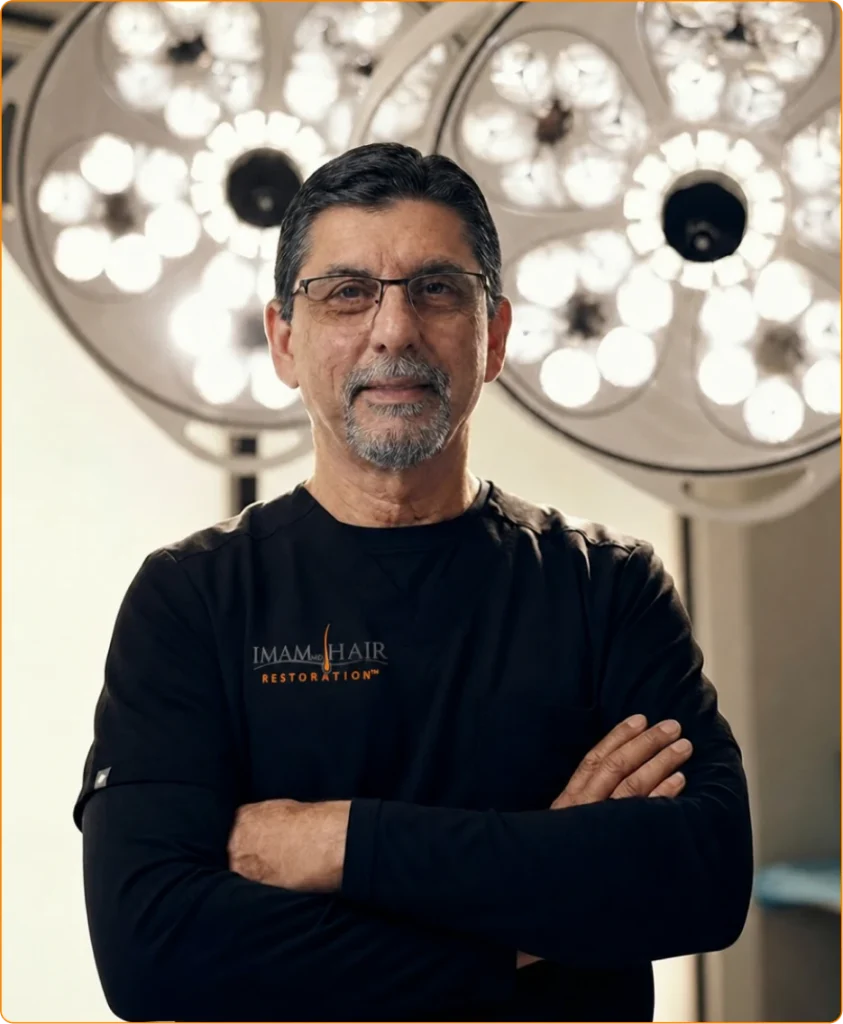
Dr. Imami is a board-certified surgeon with two additional board certifications and over 30 years of experience in hair restoration. He is recognized as one of Florida’s most trusted and skilled hair transplant surgeons, specializing in advanced techniques such as No Shave FUE, No Shave FUT, PDO threads, low-level laser therapy, medication therapies, and growth factor treatments.
He is a Member of the American Society of Hair Restoration Surgery (ASHRS), an Associate Member of the International Society of Hair Restoration Surgery (ISHRS), a Physician Member of the American Academy of Cosmetic Surgery and a Fellow of the American College of Surgeons, bringing a high level of surgical precision and patient-focused care to his work.
Dr. Imami serves on the faculty at the Burrell College of Osteopathic Medicine, where he regularly teaches medical students, and has worked with the same team of hair transplant technicians for 15 years. His passion, shared by his dedicated team, is rooted in a genuine desire to make a positive impact. He combines the scientific and artistic aspects of medicine with an understanding of the connection between appearance and psychological well-being.


Personalized Hair Restoration Care in Florida
Hair loss can affect more than your appearance; it can also impact your confidence and the way you feel about yourself. At Imami Hair Restoration, we understand that every patient’s experience is different, which is why we take the time to listen to your concerns, understand your goals, and recommend a treatment approach tailored to your individual needs.
Dr. Imami and his team take a personalized approach, carefully assessing the cause and stage of your hair loss before recommending the most appropriate treatment or combination of therapies. We welcome patients from across Florida, and same-day virtual consultations mean you can get an expert opinion without a long drive.
Common Questions
FUT Hair Transplant in Florida: Frequently Asked Questions
What is the difference between FUT and FUE?
Both FUT and FUE are effective hair transplant methods, but they differ in how grafts are harvested. FUT removes a thin strip of scalp from the donor area, which is then dissected into individual grafts. This allows maximum graft harvest in a single session, making FUT ideal for large-volume cases. FUE extracts grafts individually using a specialized punch tool, leaving no linear scar but typically harvesting fewer grafts per session. During your consultation, Dr. Imami will recommend the approach best suited to your needs and goals.
How many grafts will I need?
The number of grafts needed depends on the extent of your hair loss, your desired density, the size of the area being restored, and your hair characteristics. Dr. Imami will assess these factors during your consultation and provide a personalized estimate. Many patients achieve excellent results with 1,000–3,000 grafts, though some may benefit from more.
Will the transplanted hair look natural?
Yes, when placed by an experienced surgeon like Dr. Imami, transplanted hair looks completely natural. The key is creating the proper hairline design, angling grafts correctly, and placing them at the right depth. As individual follicular units are used and grafts are positioned artistically, the results blend seamlessly with your existing hair.
When will I see hair growth after FUT?
Hair growth after FUT is gradual. Most transplanted hairs shed within 2–4 weeks (this is normal), followed by a resting phase. New growth typically begins around months 3–4, with visible density improvement by 6 months. The final, fully mature result is visible at 12–18 months post-op. Patience is part of the process, as hair grows slowly.
Qualifying transplanted grafts that do not grow can be replaced under our Growth Guarantee.
How long will the transplanted hair last?
Transplanted hair lasts permanently as it retains the genetic characteristics of the donor area, where hair is naturally resistant to loss. This means the transplanted hair will continue to grow naturally for the rest of your life.
Is FUT painful?
Your scalp is numbed with local anesthesia before the procedure, and you receive mild sedation to help you relax. Most patients describe the experience as comfortable, with pressure or tugging sensations rather than pain. Mild tenderness after the procedure is normal and manageable with over-the-counter pain relief.
How much downtime is there after FUT?
FUT has minimal downtime compared to most surgical procedures. You can typically return to light work within 7–10 days and to normal activities within 2–3 weeks. You’ll need to avoid vigorous exercise and swimming for the first 2–3 weeks, but most people resume their regular routine relatively quickly.
Can I have another hair transplant if needed?
Yes, as FUT preserves larger untouched areas in the safe donor region, many patients have the option of a second procedure in the future if desired. Dr. Imami will discuss this during your consultation and help plan accordingly.
Can FUT be combined with other hair restoration treatments?
Yes, many patients benefit from combining FUT with Growth Factor Therapy, supplemental therapies like ACell® or PDO threads, or even non-surgical treatments like low-level laser therapy to optimize overall results and support long-term hair health.
How do I know if I'm a good candidate for FUT?
The best way to find out is to schedule a consultation with Dr. Imami. He will assess your hair loss pattern, donor hair availability, overall health, and goals to determine whether FUT is the right choice or if an alternative approach would be more suitable.
Consultation
Request a Consultation with Dr. Imami
Begin with a private, surgeon-led consultation with Dr. Imami to discuss your hair loss concerns, suitability and expected outcomes.